
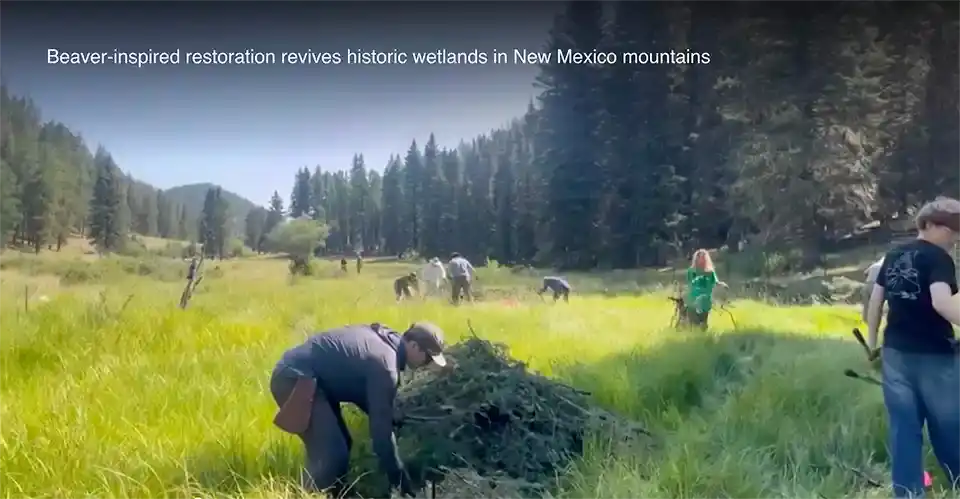
Some people might look at the marshy landscape and not believe it’s New Mexico. But it is.
The Land of Enchantment has been facing severe drought conditions for nearly a decade, but a nonprofit Rio Grande Return and its volunteers are looking to change that.
“With New Mexico’s water crisis, this is one of the most high impact things we can do,” said Rio Grande Return restoration biologist Cecil Rich. “Do a little bit of work, with people doing hand work and set the stage for beavers to start to repopulate where they were historically.”
Rio Grande Return is restoring several high-elevation streams in New Mexico, including in the heart of the Jemez Mountains near Fenton lake.
“It’s a nature-based solution to really make a big difference on a broad scale,” said Rich.
Rich said the area is one drainage over from the Valles Caldera boundary. He explained it likely was once a thriving wetland with beavers, native trees, ponds, and a complex stream system that spread across the valley’s floor.
But after decades of logging and overgrazing, beavers were driven out in the early 1800s. The stream has since become a single channel carved deep down into the ground, often preventing floodwaters from spreading onto the floodplain.
Rich said when he worked on the land about a decade ago with the U.S. Forest Service, the grasses were short and the soil was dry. Now the area is marshy, with grasses growing high.
After two days of heavy rain, water lingered on the landscape and even bubbled up from the ground several feet away from the stream.
Rio Grande Return restoration director Reid Whittlesey called the transformation “reirrigating the valley bottom.”
It’s all thanks to three years of work installing several beaver dam analogue structures of densely layered branches, logs, twigs, and mud mimicking natural beaver dams.
The restoration experts said its vital high-elevation floodplains return to their historic state because they act like sponges, storing and conserving water.
“The total amount of moisture that’s coming into the region as a whole is more or less fixed,” Whittlesey said. “What we’re trying to do is hold on to it in the headwater streams so that you can basically run a trend line through these really severe drought periods and periods where we have really great monsoons or really great snowpack.”
Whittlesey explained the benefits don’t stop at water conservation.
“Beaver dam complexes can actually really benefit downstream water quality, particularly post-fire,” he said.
He said wetlands strengthen New Mexico’s wildfire resiliency acting as natural fire breaks and safe havens for wildlife. He added they also catch debris while preventing massive flood events downstream.
Moreover, biogeochemical processes filter ash, toxins and contaminants
“These off channel anaerobic wetland sites, they have all of these very intricate biogeochemical processes that are taking those nutrients and kind of stabilizing them, holding them in the soils, taking the molecules apart into more stable and less-polluting molecules,” he said.
He said that in an era of climate change and severe drought, beaver dam complexes provide a water storage and filtration system incredibly valuable for downstream water users.
Rio Grande Return holds volunteer events every second Wednesday of the month. At the July event, participants said they enjoyed staying cool in the stream, observing wildlife, and watching their dam structures raise the water level significantly in just a matter of hours.
“I think it’s a really productive and valuable experience. I think it was very worth the time put in today and the effort to be out here,” volunteer Jonah Pratt said.
“It just makes it a lot more beautiful than before,” said 13-year-old Gus Rich
“It’s fun. You get to help the environment cool off on a hot day, you get to see wildlife and it’s just pretty cool. I saw a couple frogs in here,” said Troop 220 Boy Scout Geoffrey Phillips.
“I think this would be a really good line of work for me because I like doing this kind of stuff, helping the environment,” said Troop 220 Scout Carlos Zamora.
For now, elk exclosures are protecting recently planted aspens, willows, and cottonwoods until they can withstand browsing. Eventually the trees will provide shade for the streams and building material for beaver.
Whittlesey said there are signs that a beaver has returned to a nearby area downstream. Because beavers mate for life, he said there’s a good chance it’s looking for a partner in the newly restored habitat.
Whittlesey said the goal is to one day let beavers take over maintaining the watershed.
The endangered New Mexico meadow jumping mouse has also returned to the area.
The Forest Service is helping fund the initiative.